
Where Do Savings in Electric Car Charging Come From?
The cost of charging an electric car is not determined solely by the price per kilowatt-hour. Total expenses can also depend on the time of charging, charging power, type of electricity contract, possible capacity charges, and the pricing of any charging operator you use.
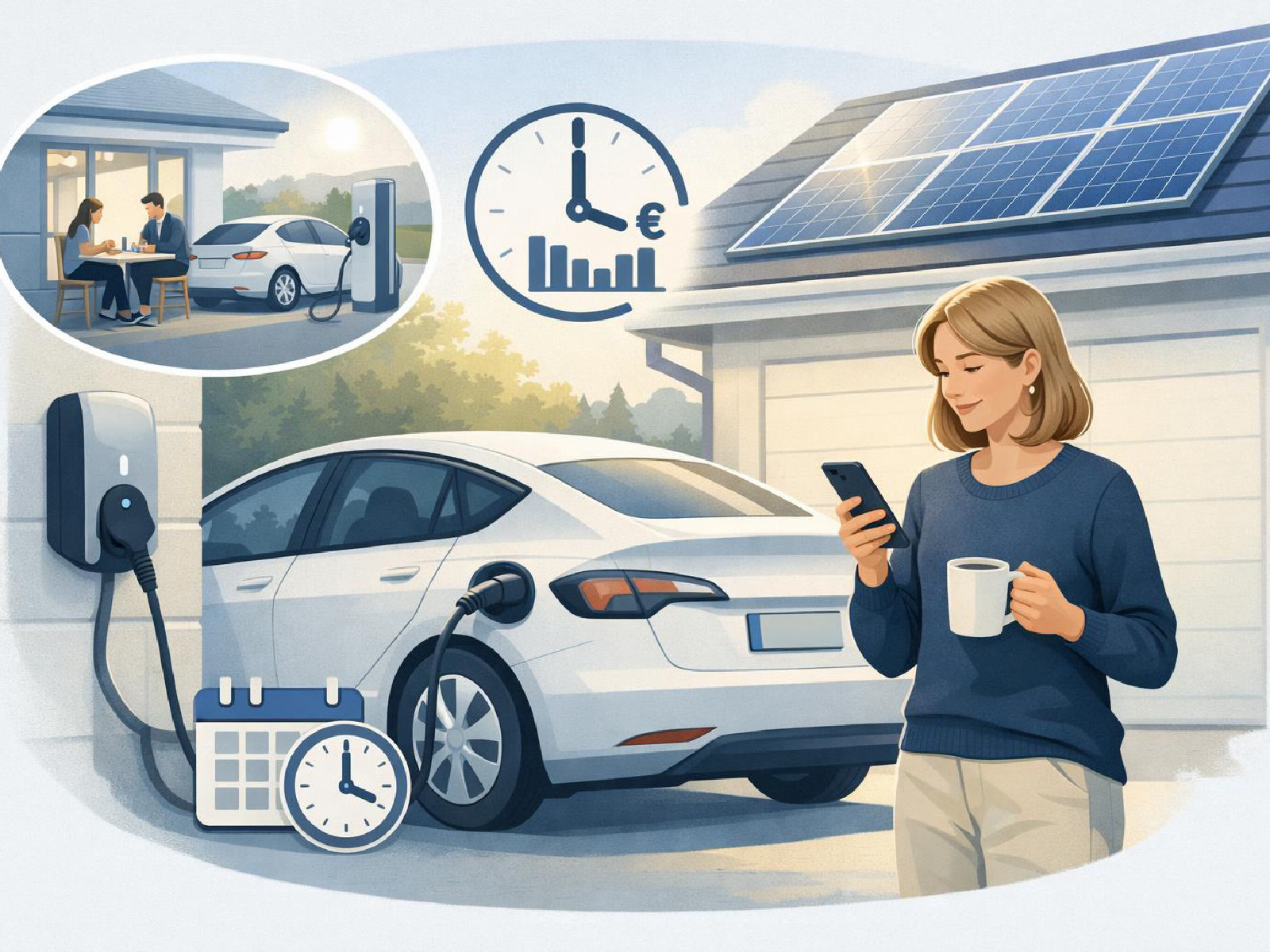
The biggest savings often come from shifting charging away from the most expensive hours. Because the car typically sits at home for long periods, charging doesn’t need to start immediately after parking. Delayed charging is worth using in both detached houses and housing companies. Most home chargers offer a timer, and if not, charging can usually be scheduled via the car itself.
You can find more content on managing everyday expenses on our article page.
Affordable Home Charging in a Detached House
In a detached house, optimising electric car charging costs is usually straightforward, because the electricity connection and contract are in the owner’s name. This makes it possible to manage all charging-related matters without intermediaries.
Spot Pricing, Also Known as Exchange Electricity
If you mainly charge your car at home and can schedule charging for the cheapest hours, a spot-priced electricity contract is often the best option. Charging consumes a lot of energy, but the timing of that consumption is flexible: the car rarely needs a full charge immediately when arriving home.
In practice, an effective solution is to combine a spot contract with scheduled charging, either in the car’s own app, the charger, or a separate control service. This way, charging targets the hours when electricity is cheapest. Lataa fiksusti helps schedule charging for cheaper hours.
A fixed-price electricity contract is a good choice if the rest of the household’s electricity use is stable and predictable, you don’t want to follow hourly prices, or you can’t schedule charging. The benefit of a fixed price is convenience: you don’t need to monitor the electricity price.
On average, a fixed-price contract ends up more expensive than spot electricity. If the electric car has to be charged immediately upon arriving home and charging can’t be delayed, the benefit of spot electricity remains small. But when charging can be shifted to cheaper hours, spot electricity is a cost-effective option for charging an electric car.
Extra Savings With Solar Power
If the property has solar panels, an electric car is an excellent way to use self-produced electricity. This is especially true on sunny summer days, when there’s plenty of electricity on the market, and its spot price can drop very low. In those situations, selling surplus production to the grid isn’t worthwhile; instead, it makes more sense to use that electricity directly to charge the car. Solar power isn’t subject to grid fees, so charging is practically cost-free.
A smart solution is to combine solar power with intelligent charging control. Then the car charges when self-produced power is available or when grid-purchased electricity is otherwise cheap.
Capacity Charge – A Subtle Enemy of Savings
Cheap energy alone isn’t enough if you repeatedly charge the car at high power at the same time as other major household consumption. With some network companies, such as Helen, total costs are also affected by a capacity charge based on peak demand. Its impact on monthly costs can be significant, wiping out spot pricing savings in an instant.
Simplified, the capacity charge is a fee for how much power you use at the same time. It’s not just about monthly consumption, but how high your momentary load peaks. If the car charges at full power at the same time as, for example, the sauna, oven, and water heater, a high consumption spike can easily occur.
You can avoid capacity charges, for example, by:
- Keeping charging power low enough that it doesn’t unreasonably increase the property’s peak loads.
- Avoiding charging at the same time as the sauna, water heater, and other large appliances.
- Taking advantage of any capacity-charge-free hours if your network company offers them.
In many homes, there’s no need to charge the car at maximum power every night. Slower charging can be more economical overall if it prevents high power peaks.
Charging an Electric Car in a Housing Company
In a housing company, charging is rarely something a single resident can decide alone. The best outcome usually comes when charging is solved as a whole, and the system isn’t allowed to grow haphazardly based on individual chargers. Careful planning matters.
A Practical Charging Solution for Housing Companies
A good starting point is for the housing company first to determine the capacity of its electricity connection, expected future demand, and any need for load management. Based on this, it can decide whether to build charging infrastructure gradually or fully for several spots at once. The key idea is that in a housing company, charging is primarily a property-level infrastructure issue, not just a convenience feature for individual drivers. If the system is built only for the first users’ needs, it may later turn out to be a poor solution and expensive to fix.

A commonly effective model looks like this:
- The housing company owns the entire charging infrastructure and defines the rules and costs for its use.
- Charging points include consumption metering and load management.
- Residents are billed either based on actual consumption, a fixed monthly fee, or a combination of both.
- Charging is scheduled for cheaper hours where possible, or costs are otherwise allocated fairly.
If the company allows completely separate individual solutions without central management, the result can be unfair cost-sharing, complicated billing, and, in the worst case, capacity problems in the electrical system.
For most housing companies, the best option is a centralised system where charging infrastructure, metering, and load management are implemented as one package. This also makes it easier to add new charging points later. Implementing such a system often requires cabling upgrades to meet higher capacity needs.
Fair Distribution of Costs
The cost-sharing model in a housing company should be clearly and transparently agreed in advance. Typical options include:
- The resident pays only for actual energy use based on kWh.
- The resident pays a monthly fee in addition to consumption to cover system maintenance and services.
- The investment is covered via maintenance charges, and usage is billed separately.
Usage-based billing is often the fairest option when there are many users and consumption varies. A monthly fee can still be justified if it covers, for example, system maintenance, fault monitoring, payment processing, and servicing. Allocating the capacity charge to individual users is difficult, because it’s based on the property’s total simultaneous peak consumption. In practice, other fixed costs can be rolled into the kilowatt-hour price so that cost allocation stays clear and predictable.
It also makes sense to review pricing a few times a year so that it matches actual costs, the general electricity price level, and system maintenance expenses.
Charging Operator – Extra Cost for Convenience
In many housing companies, using a charging operator is a sensible choice. The operator handles user management, authentication, consumption metering, reporting, and even billing. This means the board or property manager doesn’t need to spend time sorting out individual charging sessions.
The operator model is usually not the cheapest possible, but it can clearly be the lightest administratively. A small housing company can also manage with a simpler solution, as long as metering, load management, and cost allocation are properly planned. There are several charging operators on the market, but the essential issue isn’t which operator, but that responsibilities, metering, and billing are clearly defined.
When choosing a charging operator, it’s worth checking that the company is financially sound and the service is long-lived. The system should allow flexible pricing and fair allocation of costs to users. A good solution offers predictable pricing, reasonable fixed fees, and the possibility to switch providers later without major restrictions. Any data connections should preferably be in the housing company’s name.
Allocating the Capacity Charge
In a housing company, managing capacity charges and consumption peaks is especially important, because several cars might be charged at the same time. If every car starts charging at full power after the workday, costs can rise surprisingly high.
That’s why housing companies benefit from solutions that allow charging to be:
- Shared dynamically between several cars.
- Automatically limited to lower power during peak periods.
- Shifted to night-time or other cheaper hours.
A simple way to steer charging away from capacity-chargeable hours is to set daytime charging prices unreasonably high.
Charging an Electric Car on the Road
At home, the lowest cost usually comes from timing your charging. On the road, the main difference comes from what kind of charging you use and at what electricity price.
Slow Charging – Often the Best Option
If the car stays parked for a longer period, for example, at a hotel, at work, or during a long break, basic or slower charging is often the smartest option. The reason is simple: there’s no point paying for speed if there’s no real need for it.
Slow charging is often a good choice because:
- The price per kilowatt-hour is usually lower than at high-power fast chargers.
- There’s no need to push the car’s battery with very high charging power.
- Charging can be combined with parking or other errands without a separate waiting time.
- Total travel costs stay lower, even if an individual charging session takes longer.
Fast and high-power charging are useful when you want to continue your trip quickly. In practice, they’re paid convenience services: charging is fast, but that’s often reflected in the price, and the battery also wears out faster.
A simple decision model looks like this:
- If the car is going to be parked for a longer period, slow or basic charging is usually the smartest option.
- If the stop is roughly the length of a meal break, standard DC fast charging can be a good compromise.
- If the goal is to get back on the road as quickly as possible, high-power charging is justified even though it’s more expensive.
Comparing Apps and Prices
Anyone charging on the road benefits from installing the most common charging apps on their phone before setting off. In practice, the price of charging can vary significantly depending on the station, operator, contract, and app used. Even at the same station, different service providers can have very different prices. Nowadays, these prices can also vary by time of day.
A good practice is to have at least a few common charging apps on your phone. In Finland, for example, you might encounter services like Recharge, Virta, or ABC-lataus. This way, you don’t have to register in a hurry on the road, search for a payment card, or accept the first price you see.
It’s worth comparing prices before starting a charging session, and preferably already before the trip, because the differences can be large. Some services also offer monthly subscriptions or loyalty levels that suit frequent drivers but not occasional users.
On the road, the solution is therefore preparation: accounts set up in advance, payment methods ready, and checking the price before starting to charge.
If you often pay with your phone, have a look at our guide to mobile wallets as well.
A Practical Plan for Low-Cost EV Charging
Affordable charging doesn’t require constant price monitoring once the basics are in place. For many, the following approach works well:
- Use a dedicated home charger and schedule at home.
- In a detached house, choose a spot-priced contract if you can shift consumption to cheap hours.
- In a housing company, make use of metering and load management.
- Keep charging power only as high as you actually need.
- Whenever possible, direct solar power to your own car, especially during sunny and cheap hours.
- On the road, use fast charging only when saving time really matters.
- Install several charging apps on your phone to compare prices.
The Cost of Charging
The price of charging an electric car varies widely depending on where and how you charge. The biggest differences come from whether you use home charging, a housing company’s system, or public chargers on the road.
In a Detached House
Charging in a detached house is usually the cheapest option. In an optimal situation, the cost can be as low as about 9 cents/kWh if you have a spot-priced contract and systematically time charging to the cheapest hours.
In practice, this requires scheduling charging with the car’s app or the charger, shifting consumption away from expensive hours, avoiding power peaks, and using solar power where possible.
Without optimisation, the price is often clearly higher, but still usually lower than at commercial chargers.
In a Housing Company
In a housing company, a good and realistic overall charging price is often around 14 cents/kWh. This is achievable when charging is metered, costs are allocated correctly, and load management is in use. It usually also requires sufficient volume to spread fixed costs across many users.
Charging prices in housing companies are generally higher than in detached houses, because they often include investment costs, maintenance, system services, and possibly the impact of capacity charges. These aren’t as easy to optimise for an individual user.
On the Road
At public charging points, a typical price is around 25 cents/kWh, but there’s a lot of variation. Sometimes you can charge less, for example, at supermarkets, hotels, or other destinations.
Fast and high-power charging are usually the most expensive options. The price can be around 35 cents/kWh or higher, and in some cases even up to 80 cents/kWh.
On the road, you mainly pay for speed and convenience. The cheapest options usually appear when you can combine charging with parking or other errands and don’t need the fastest possible charging.
Typically, an electric car uses about 12–20 kWh/100 km, depending on driving conditions.
Bottom Line
You can cut electric car charging costs significantly with just a few basic choices. The most important steps are scheduling charging outside the most expensive hours, keeping power peaks under control, and avoiding unnecessarily expensive fast charging when slower charging is sufficient. With poor optimisation, running an EV can become as expensive as driving a petrol car.
In a detached house, the situation is usually straightforward, because your electricity contract largely determines your costs. In a housing company, savings come from implementing charging as a shared, metered system with load management. On the road, the lowest costs go to those who compare prices instead of automatically choosing the fastest option.